Refrigeration has become a complex balance of storage capacity, cabinet dimensions, cooling performance, energy use, and market-specific design. Behind every finished appliance sits a network of decisions involving engineering, materials, manufacturing processes, quality control, and supply coordination. Choosing the right refrigerator manufacturer therefore involves much more than comparing exterior designs or retail prices. With its focus on cooling products and international ODM services, Homa Appliances operates within this broader manufacturing landscape, where product development needs to respond to different household habits and market requirements.
How Refrigerator Engineering Has Evolved
Modern refrigerators rely on several systems working together rather than one isolated cooling component. The compressor compresses and drives refrigerant through the refrigeration cycle, while the evaporator absorbs heat from the interior and the condenser releases that heat into the surrounding environment. Insulation then helps reduce unwanted heat transfer through the cabinet.
Cabinet construction also influences usable performance. Door seals need to maintain close contact with the frame, while insulation thickness and material properties affect the rate of heat transfer through the cabinet. These engineering choices can influence both temperature stability and electricity consumption during everyday operation.
Internal organization presents another design challenge. More nominal capacity does not necessarily mean more practical storage if shelves, drawers, and door bins are difficult to access. Product development therefore considers the relationship between external dimensions and the space customers can actually use.
Capacity Should Be Considered Alongside Dimensions
Refrigerator capacity is often one of the first specifications buyers examine, yet the number alone provides limited information. Two models with similar total volume can offer very different experiences depending on the proportion allocated to fresh-food storage, frozen storage, drawers, and door compartments.
External measurements matter just as much, particularly in kitchens with fixed cabinetry. Height affects overhead clearance, width determines how much floor space the appliance occupies, and depth influences how far the cabinet projects beyond surrounding furniture. Installation planning should account for door movement and required ventilation space as well.
These considerations are especially relevant when an appliance needs to balance substantial storage with a relatively controlled footprint. For appliance developers, such trade-offs influence cabinet architecture from the earliest design stage rather than being addressed only after the cooling system has been selected.
Inside The Specifications Of FF2-55D
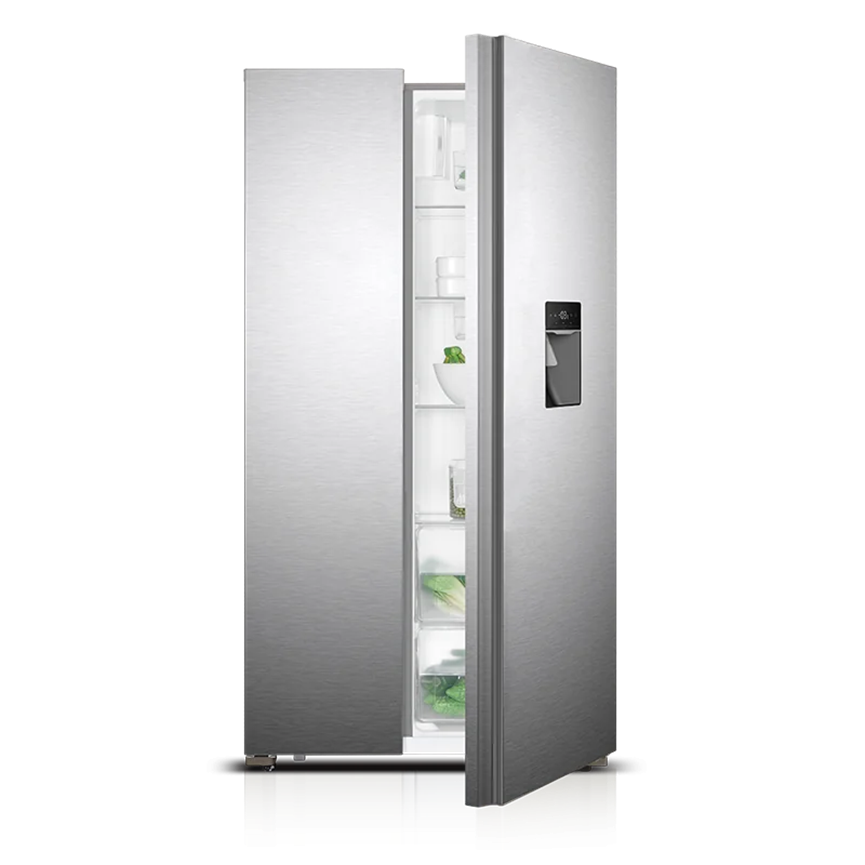
One example from Homa’s product portfolio is the FF2-55D, whose published dimensions are 177 cm in height, 91 cm in width, and 58 cm in depth. Its total net capacity reaches 439 liters, with 288 liters allocated to the refrigerator compartment. The figures illustrate how product specifications can reveal the relationship between cabinet size and usable storage without relying solely on exterior appearance.
Reading those numbers together gives buyers a clearer basis for comparison. The 58 cm depth, for instance, provides useful context when considering kitchen installation, while the 288-liter net fridge capacity indicates that a substantial portion of the internal space is dedicated to refrigerated rather than frozen storage. Such information is more useful when matched against actual household requirements.
What To Look For In A Manufacturing Partner
Production scale is only one consideration when evaluating a refrigerator manufacturer. Engineering resources, product-development capabilities, quality management, supply-chain coordination, and experience with different markets can all affect the development process. International buyers may also require adaptations related to dimensions, electrical standards, climate conditions, labeling, or consumer preferences.
Consistency matters throughout manufacturing. Refrigerators contain multiple interconnected components, so variations in assembly, sealing, insulation, electrical parts, or cooling-system installation can influence the final product. Structured testing and inspection help identify issues before products reach distribution channels.
Communication between product development and manufacturing teams is equally important. Changes to cabinet dimensions or interior layouts may affect packaging, component placement, tooling, logistics, and production procedures. A manufacturing partner capable of coordinating these areas can make product development more practical for brands serving multiple regions.
Why Market Requirements Shape Refrigerator Design
Household habits differ considerably from one country to another. Some consumers prioritize fresh-food capacity, while others place greater value on freezer space or compact installation. Climate also matters because surrounding temperatures can influence refrigeration workload and the operating conditions for different appliance designs.
Different target markets create another layer of variation. A model intended for an urban apartment may prioritize dimensions and storage efficiency, whereas products for larger households may emphasize capacity and flexible organization. Product portfolios consequently tend to include several formats rather than relying on one universal configuration.
Technology choices must also fit the intended market. No-frost systems, defrost configurations, built-in formats, side-by-side layouts, and multi-door designs each address different priorities. The refrigerator manufacturer must translate those requirements into practical engineering specifications without losing sight of production feasibility.
Conclusion
Refrigerator manufacturing combines thermal engineering with cabinet design, storage planning, production control, and market adaptation. Capacity figures become meaningful only when considered alongside dimensions and compartment allocation, while manufacturing capability extends beyond the factory floor into development, testing, supply coordination, and regional customization.
For buyers evaluating refrigeration partners, these factors provide a more useful framework than appearance or price alone. Through its cooling-focused portfolio and ODM capabilities, Homa Appliances represents the type of manufacturing partner positioned around the varied technical and commercial requirements of international refrigeration markets.
0 Comments